Benriner Mandoline Slicers
Identical slices, set by a dial with no click stops
A Benriner is a hand-operated Japanese mandoline: a ribbed bed, an exposed stainless blade, and a dial that raises or lowers the cutting surface anywhere from about 0.5 mm upward. Nothing plugs in and nothing needs assembly. Three widths cover most kitchens, 64 mm for everyday vegetables, 95 mm once onions and cabbage are involved, 120 mm when the produce is genuinely large.
Shop Benriner Mandoline Slicers
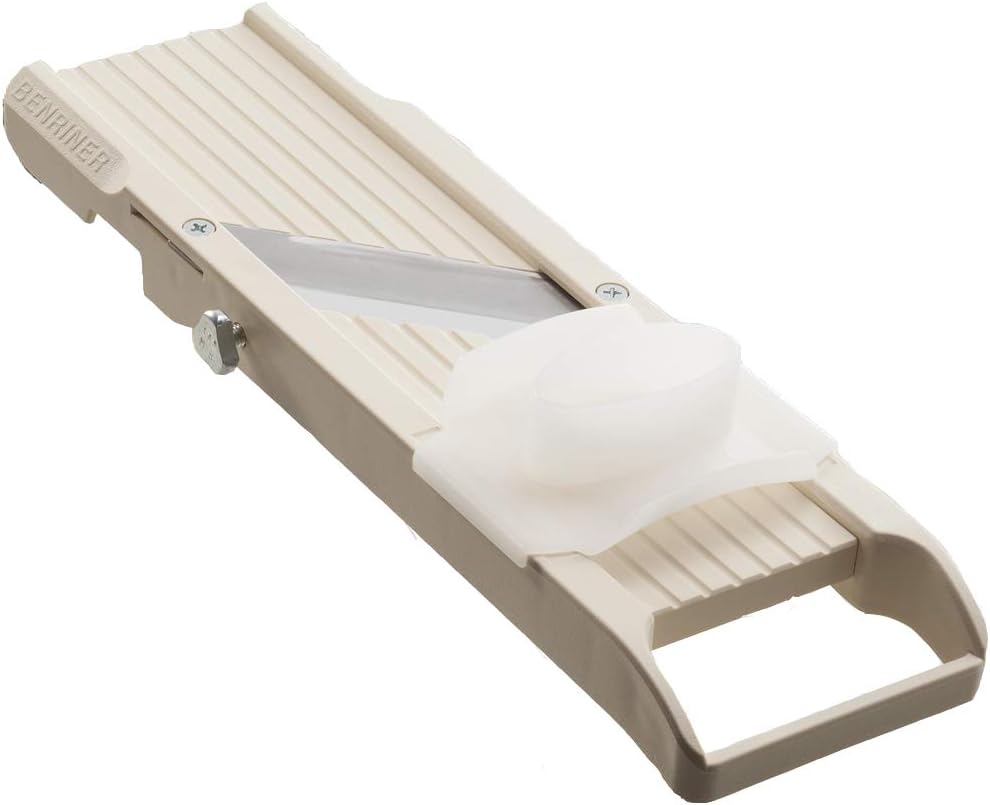
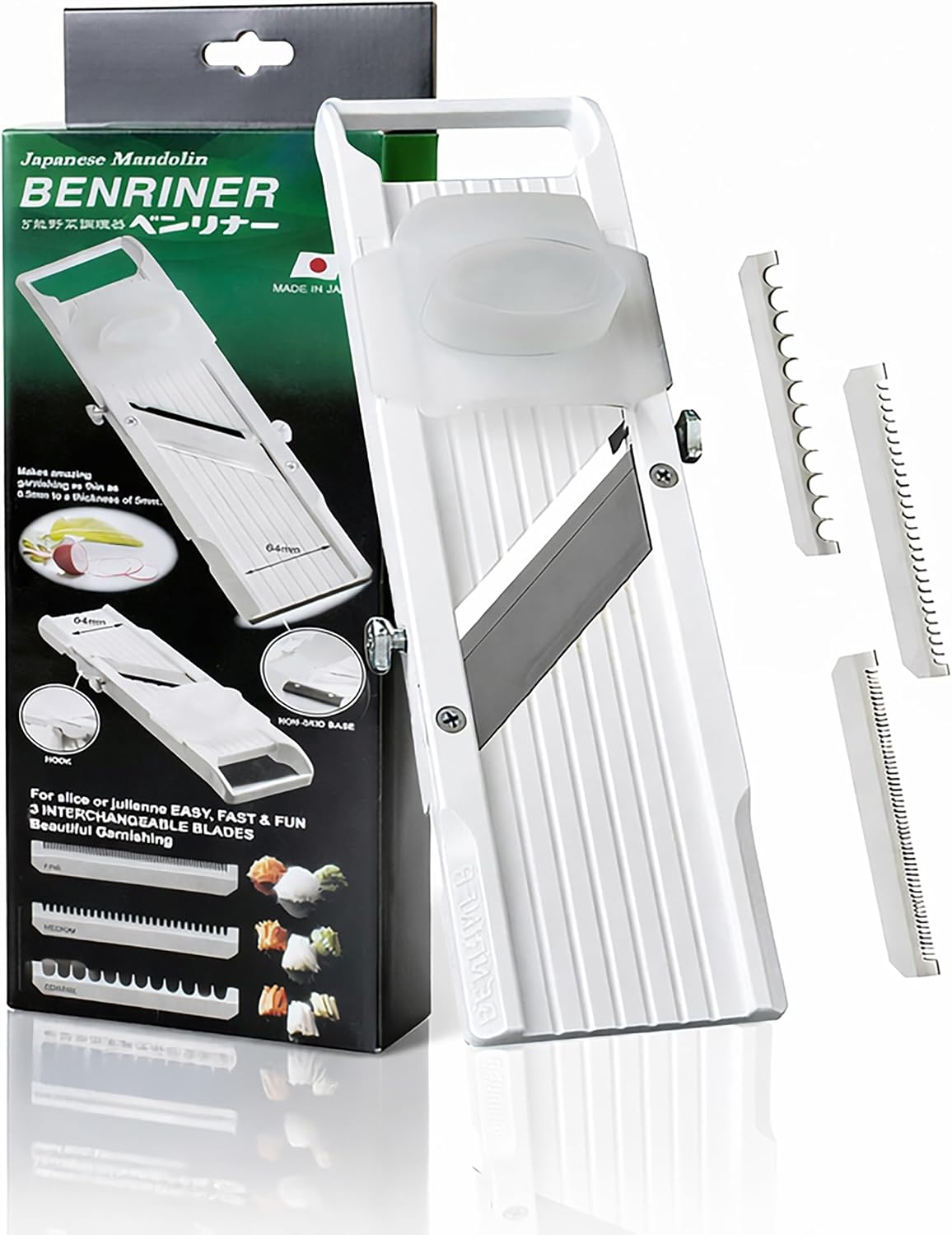
Benriner No. 64
A 64 mm bed, near 2.5 inches, which is enough for cucumbers, carrots, radishes and ordinary potatoes without cutting them down first. The dial covers roughly 0.5 to 5 mm. It takes the least drawer space of any Benriner.
Check availability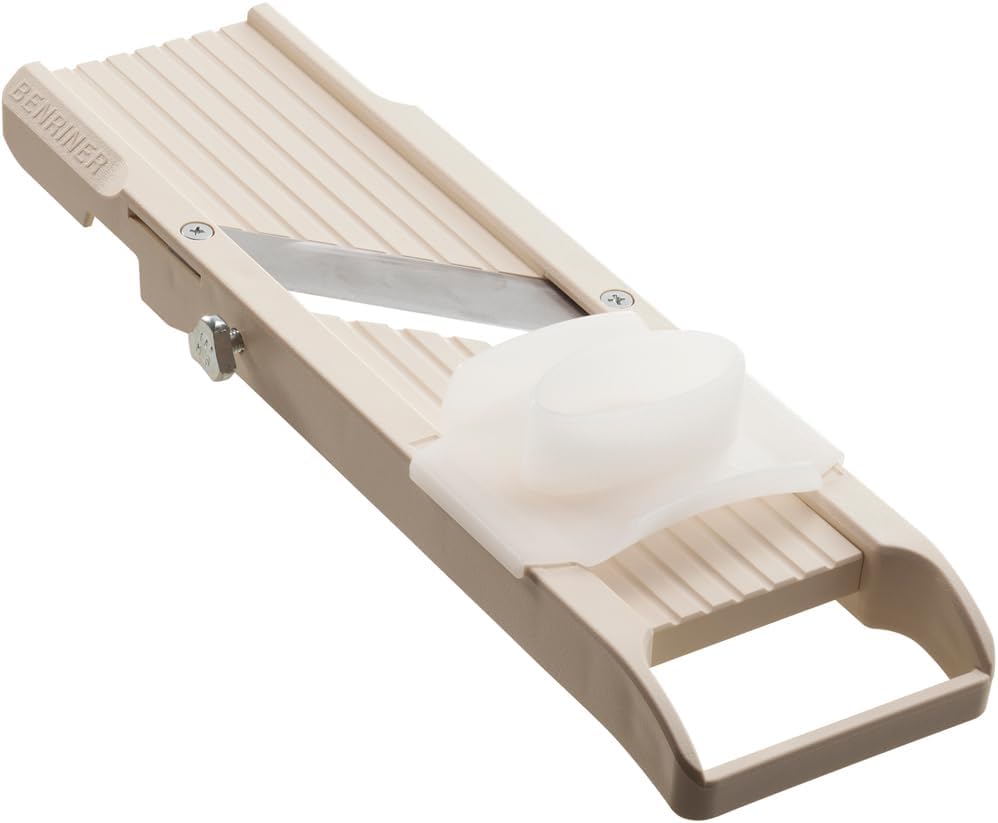
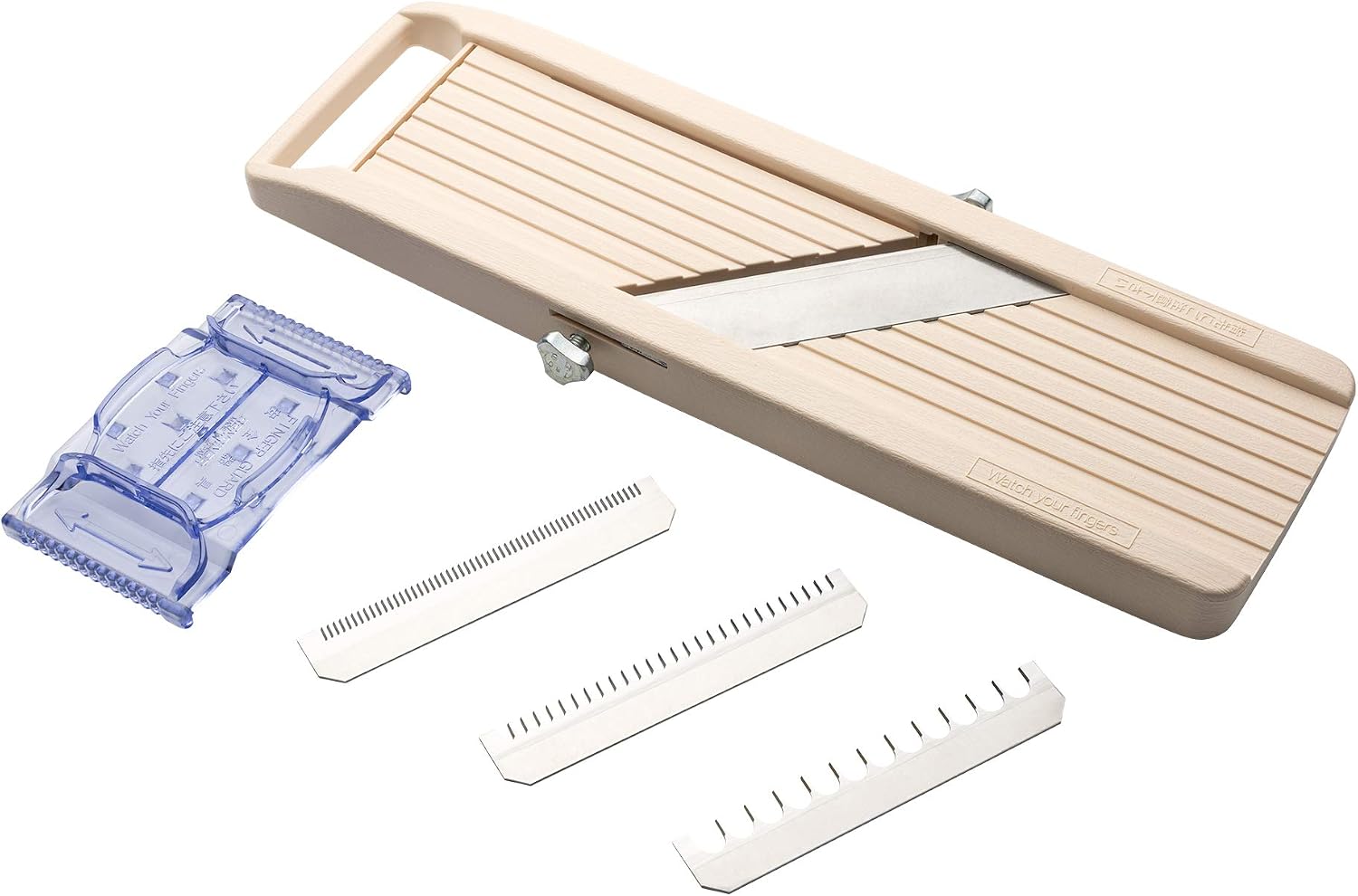
Benriner Mandoline Slicer, 4 Blades
The beige four-blade version most US kitchens end up with. The body runs 12.75 by 3.625 inches over a 2.5-inch cutting surface, in BPA-free plastic with Japanese stainless blades. One flat blade slices, three comb blades cut strips.
Check availability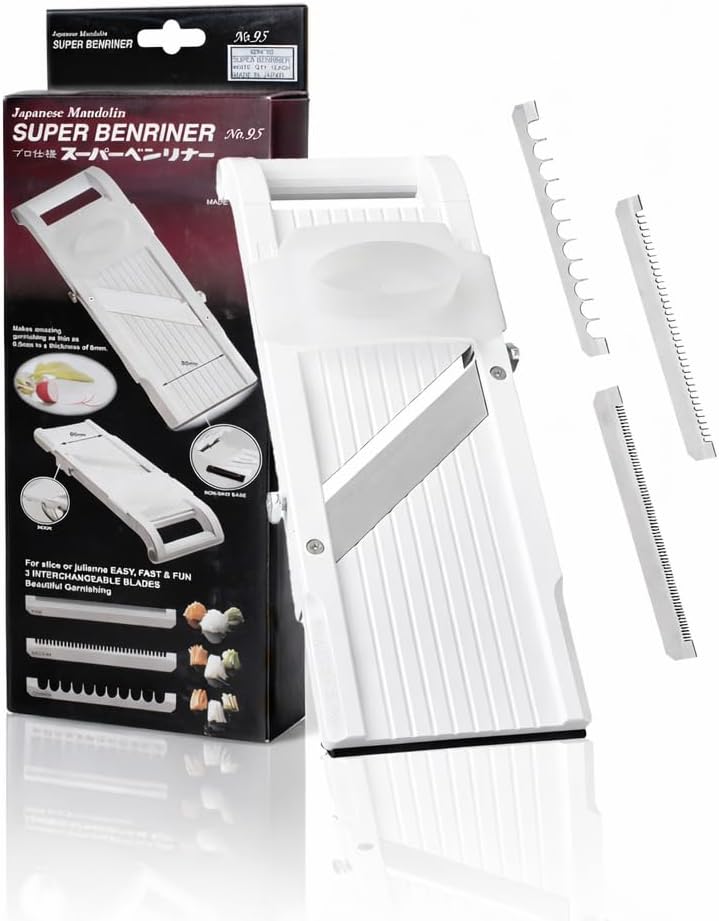
Super Benriner No. 95
95 mm across, near 3.7 inches, so a whole onion or a quarter of a cabbage stops hanging off both sides. Thickness reaches about 8 mm. A rubber strip along the base holds it still and the front ledge sits on a bowl rim.
Check availability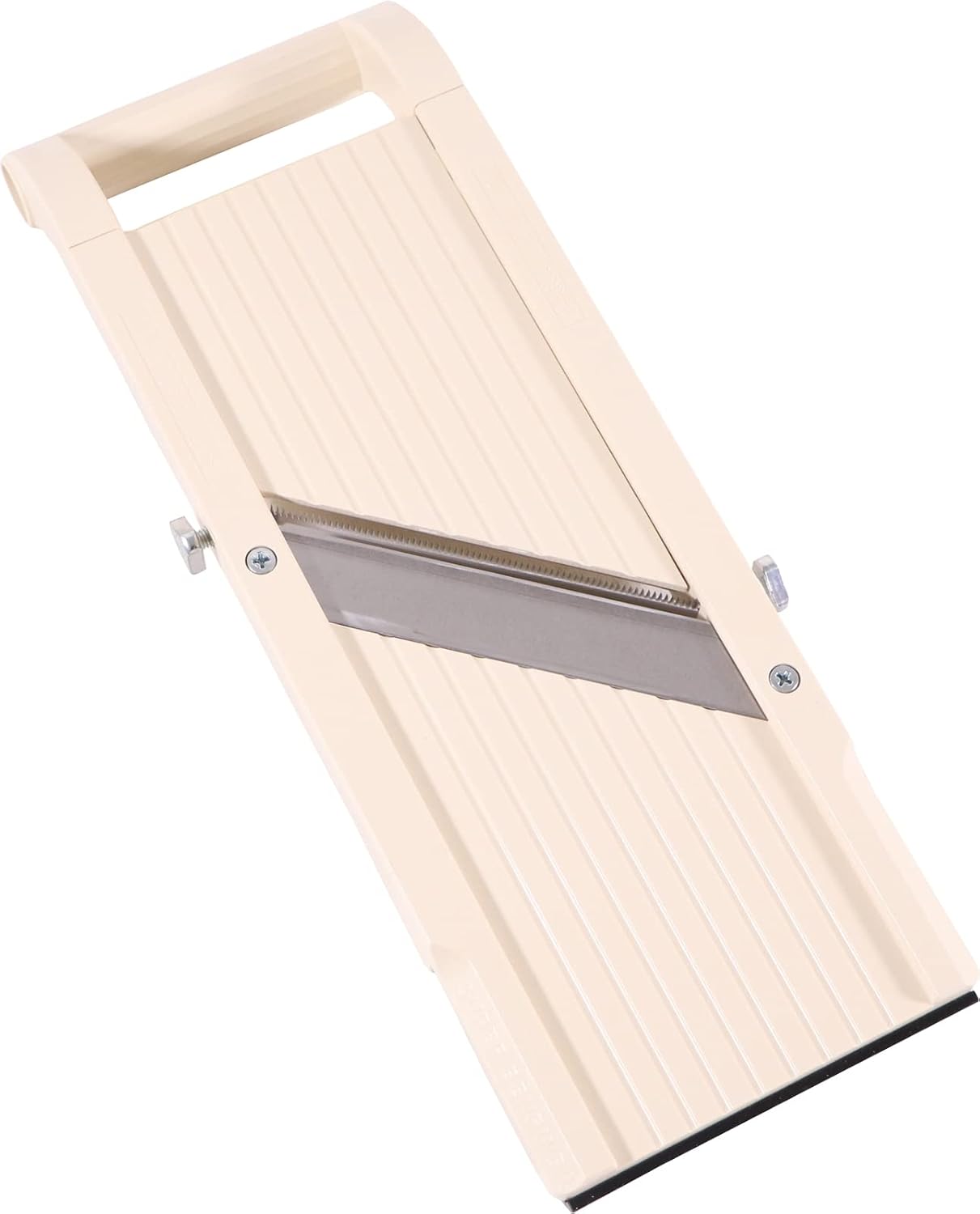
Benriner Super Slicer, Beige
Same 95 mm surface in the beige body, listed in the US as the Super Slicer at 14.5 by 5.25 inches. The bed and the dial come apart for washing exactly as they do on the white version.
Check availability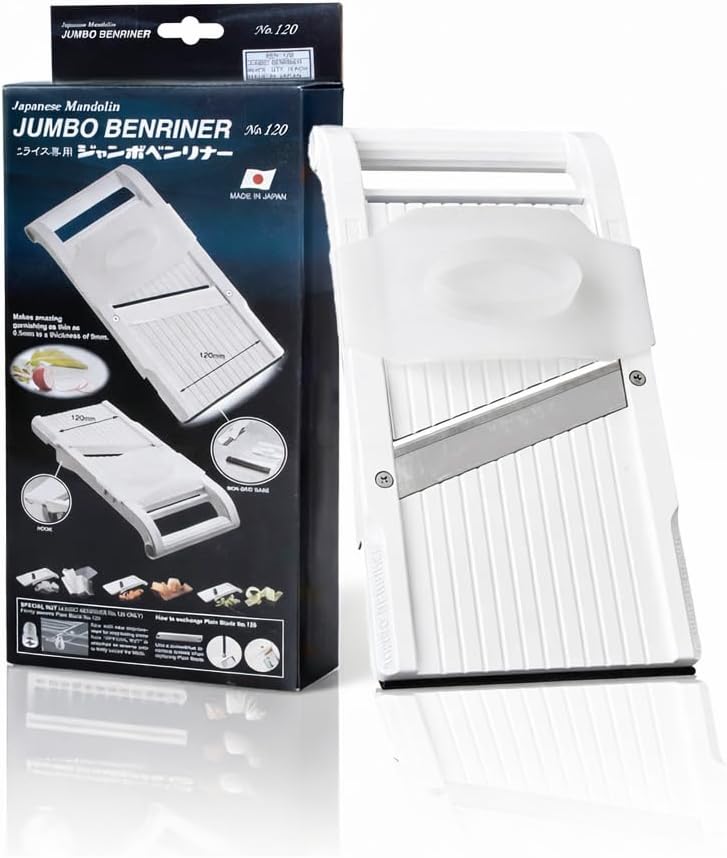
Jumbo Benriner No. 120
120 mm of width, roughly 4.7 inches, for melon, large eggplant and half a cabbage in one pass. The dial reaches about 9 mm. Many Jumbo packages hold the straight blade only, so read the contents if you want julienne.
Check availability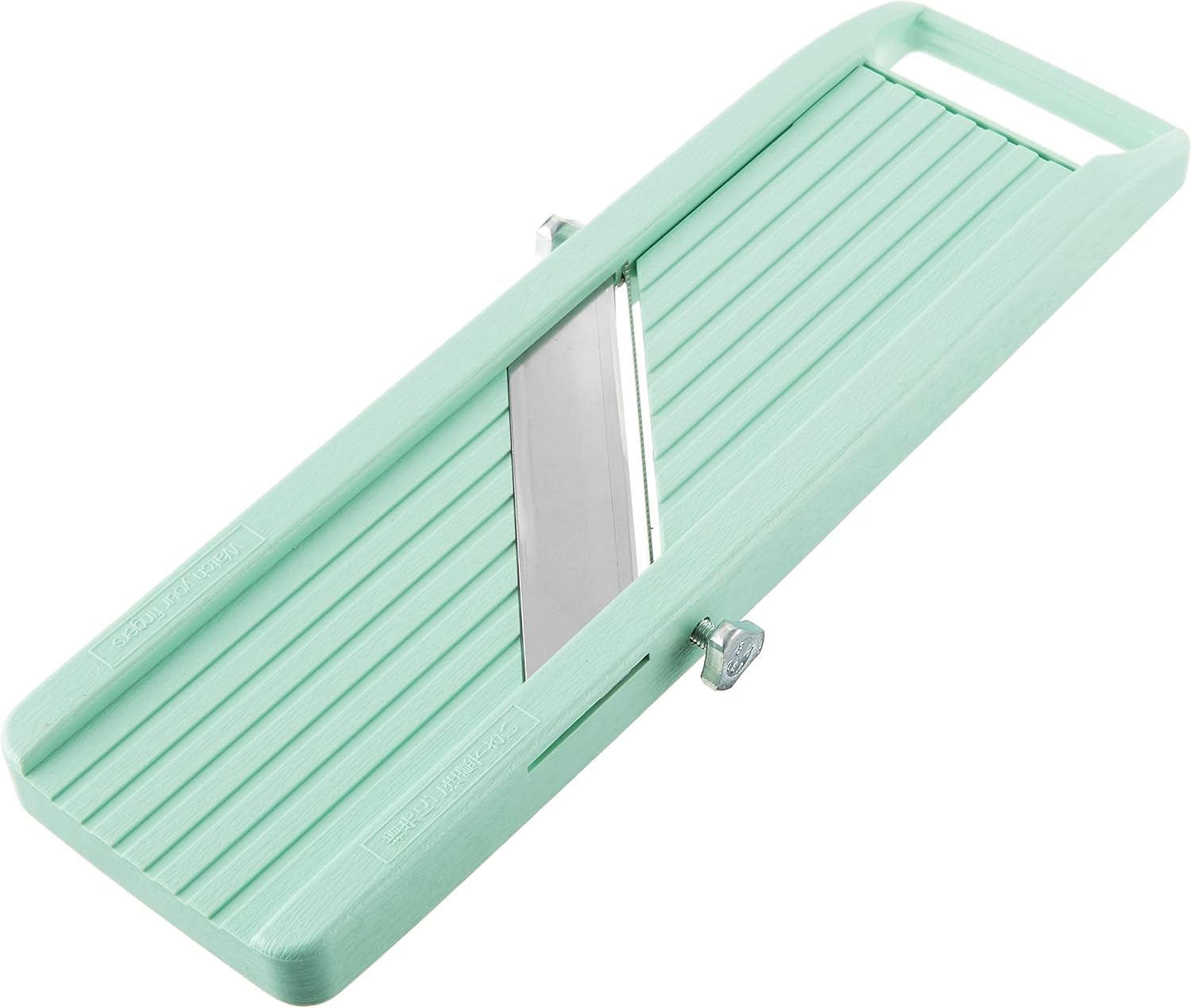
Benriner Green, Older Version
An earlier generation still in circulation, because these bodies outlast the edge that came with them. Roughly 12.4 by 3.7 inches in ABS resin. Measure yours before ordering parts, since current blades do not automatically fit an older body.
Check availabilityOther formats and genuine parts
Four-blade set with finger guard
No. 64 in retail packaging
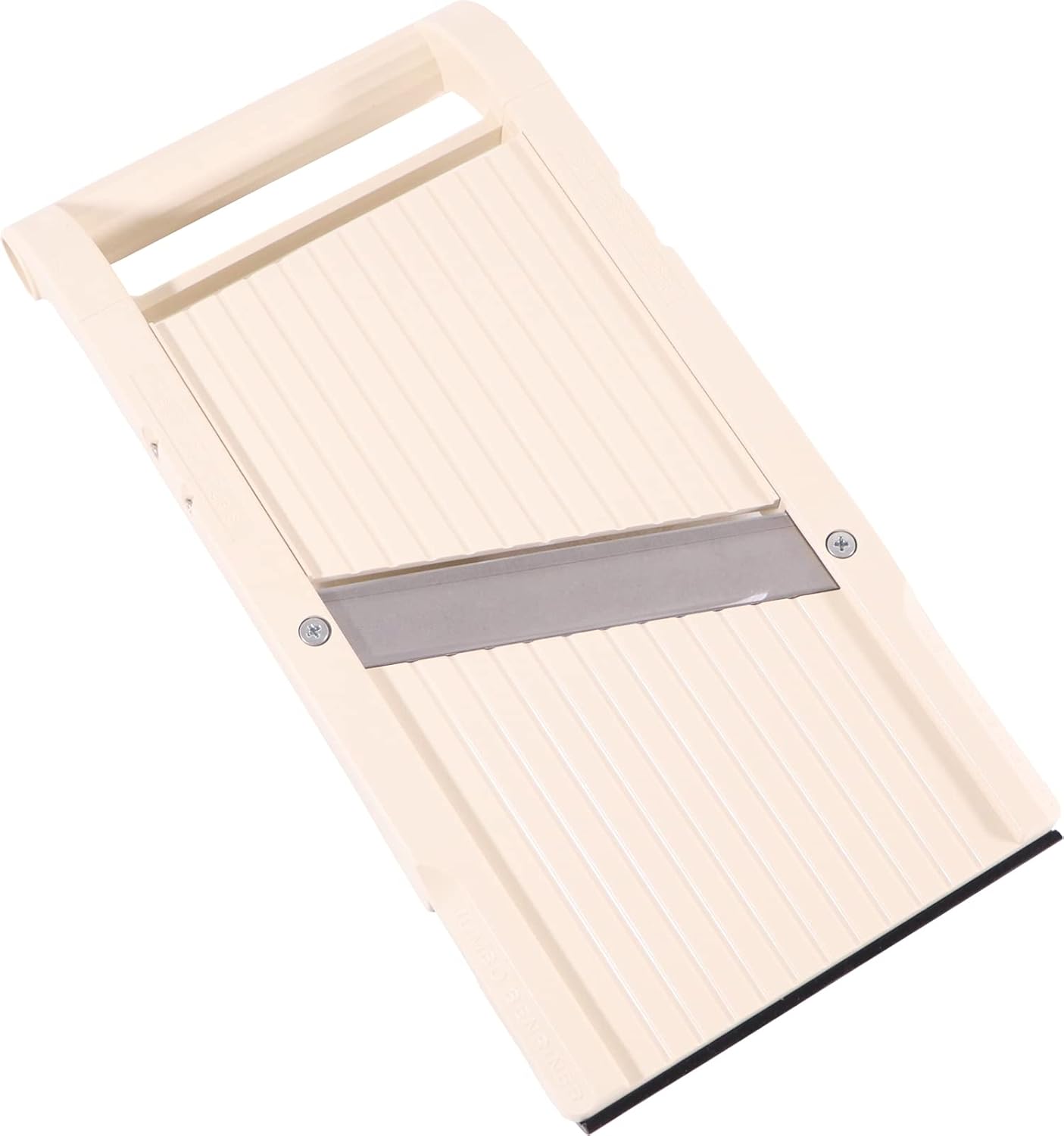
Jumbo No. 120, beige body
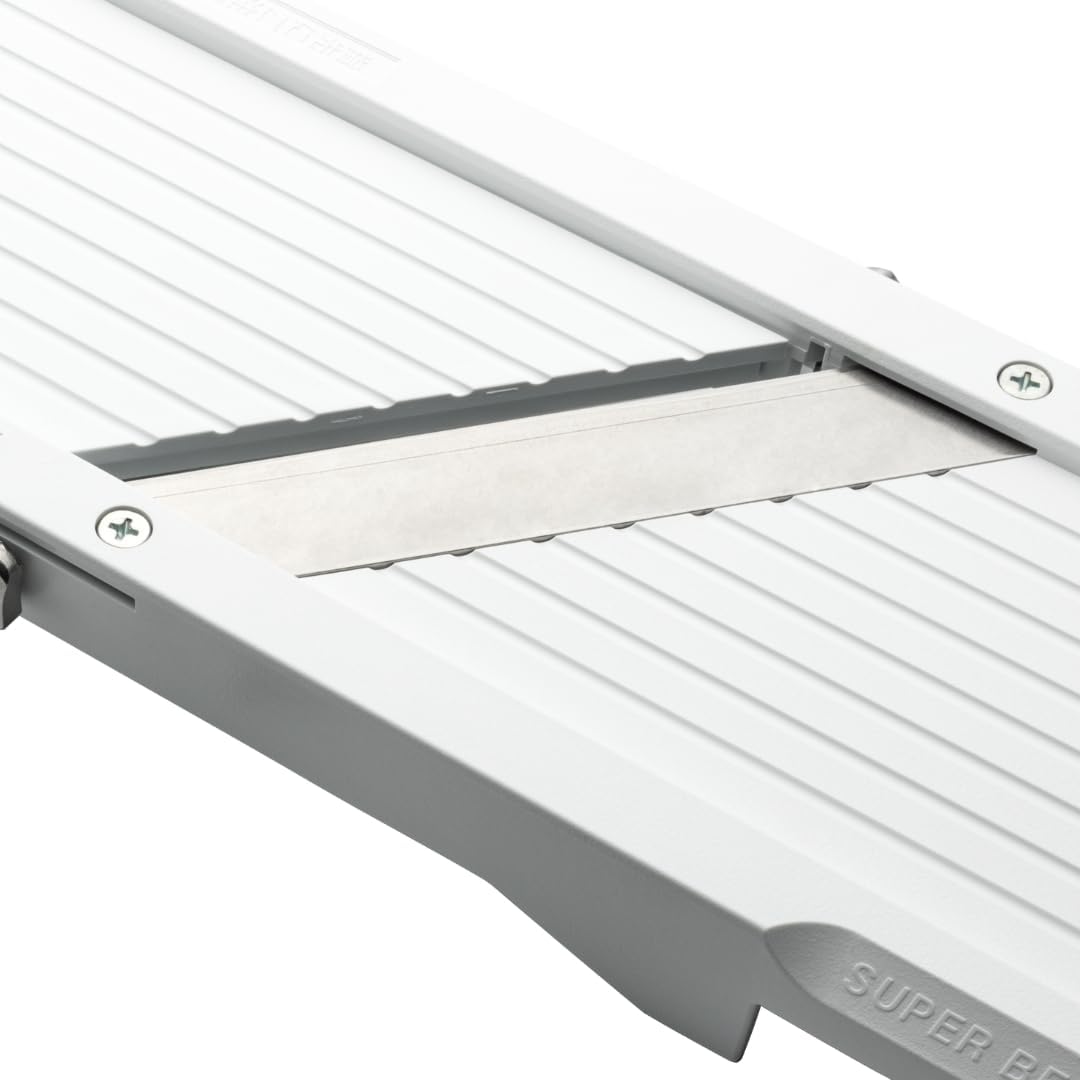
Replacement flat blade, No. 95 and No. 120
Body color has changed across production periods and tells you nothing about the width. Read the model number, and check whether comb blades are in the box before you count on julienne.
No. 64, Super No. 95 or Jumbo No. 120
Benriner No. 64
The compact one. A 64 mm bed handles a surprising share of home prep, and the slicer disappears into a drawer between uses.
- Cucumber, carrot, radish, zucchini, smaller onions and everyday potatoes
- Thickness from about 0.5 to 5 mm on the dial
- Four-blade sets add 1 mm, 3 mm and 7 mm comb blades
- Wide produce has to be halved or trimmed before it fits
Super Benriner No. 95
The middle ground, and the one most cooks reach for after outgrowing the No. 64. An extra 31 mm of width removes most of the trimming.
- Whole onions, larger potatoes, eggplant, apples, cabbage sections
- Thickness from about 0.5 to 8 mm
- Comb blades run roughly 1 mm, 3 mm and 11 mm
- Still fits a deep drawer at 14.5 by 5.25 inches
Jumbo Benriner No. 120
Width first, everything else second. Nothing else in the range makes a slice this wide in a single uninterrupted pass.
- Melon, big cabbage sections, wide onions, substantial eggplant
- Thickness from about 0.5 to 9 mm
- Around 13 by 6.5 inches, so storage costs more room
- Julienne combs are frequently not in the box; check before ordering
The right width is the smallest one that takes the produce you handle every week. A narrower slicer weighs less, stores flatter and gets pulled out more often, which is the whole point of owning one.
Four Things Worth Knowing Before You Order
The dial has no click stops
Turning it raises or lowers the whole cutting bed instead of jumping between four or five preset positions. That is the reason cooks pick a Benriner over a stepped mandoline. It also means the number in your head is a starting point, not a guarantee, so cut one slice and look at it before committing the rest of the vegetable.
One flat blade, three comb blades
The flat blade does the slicing on its own. Drop in a comb insert and the ingredient gets divided into strips on the way past it, which is how the same tool produces fine threads for garnish and thicker batons for a stir fry. Comb spacing is model specific and has changed between generations.
The guard is the safety system
There is no enclosed feed chute here. The blade sits exposed and it is genuinely sharp, which is what makes the cut clean. The supplied guard only works while it has a firm grip on the food, so a cut-resistant glove earns its place on small, round or slippery pieces. When the piece gets too short to hold, that piece is finished.
Hand wash, never the dishwasher
Dishwasher heat deforms the plastic body, which is why current models are hand wash only. The dial and the cutting bed lift off so you can reach around the blade with a brush. Wash it soon after use, because starch dries hard around the edge and carrots and beets stain light plastic.
Which Setting for Which Cut
| What you are cutting | Setting and blade | Worth knowing |
|---|---|---|
| Potatoes for gratin | 2 to 3 mm, flat blade | Even slices soften at the same rate in the dish |
| Potato chips | Near 1 mm, flat blade | Rinse the starch off before anything hits the oil |
| Cucumber for sunomono | 0.5 to 1 mm, flat blade | Trim one flat face so the round stops rolling |
| Cabbage for slaw | 1 to 2 mm on the No. 95 or No. 120 | Quarter the head and slice through the cut face |
| Onion rings and half moons | About 2 mm, flat blade | Half moons stay together better than full rings |
| Radish and daikon garnish | Thinnest setting, flat blade | Slices turn translucent at the bottom of the range |
| Carrot julienne | Fine or medium comb blade | 1 mm threads for garnish, 3 mm for stir fries |
| Apples and firm pears | 2 to 4 mm, flat blade | Lemon water keeps the cut faces from browning |
- Dense produce at a thick setting takes real force. Sweet potato at the thick end of the dial is hard work on a No. 64, and a worn edge makes it worse.
- Firmness, hand pressure and blade condition all pull the finished slice away from the number on the dial. One test pass costs a few seconds and settles it.
- Chopping, dicing and any cut around a pit still belongs on a cutting board. A mandoline repeats one flat plane and nothing else.
Super No. 95 and No. 64 Side by Side
Super Benriner No. 95
The wide-bed reference
- Cutting width
- 95 mm / 3.7 in
- Thickness range
- 0.5 to 8 mm
- Comb blades
- 1, 3 and 11 mm
- Blade
- Japanese stainless steel
- Body
- BPA-free plastic
- Retail size
- 14.5 x 5.25 in
- Made in
- Japan
These are the numbers to compare anything else against. The extra width over a No. 64 is what stops you quartering an onion before you can slice it, and 8 mm at the top of the dial covers roasting and thick pickle cuts that the smaller body cannot reach.
Benriner No. 64
The compact reference
- Cutting width
- 64 mm / 2.5 in
- Thickness range
- 0.5 to 5 mm
- Comb blades
- 1, 3 and 7 mm
- Blade
- Japanese stainless steel
- Body
- BPA-free plastic
- Retail size
- 12.75 x 3.625 in
- Made in
- Japan
Narrower and lighter, which is the whole point. It sits over a cutting board or hooks onto a bowl, weighs almost nothing and stores flat. The trade is width: anything broader than 64 mm needs halving before it will run across the bed.
- The model number decides which blade fits. No. 64 parts are cut for a 64 mm bed, and current listings show the Super No. 95 and the Jumbo No. 120 sharing one wider flat blade.
- Comb spacing has moved between generations. A 7 mm coarse insert for a current No. 64 is a different part from the 11 mm coarse insert sold for the No. 95.
- Package contents vary by region and production run. Four blades are usual on the No. 64 and the No. 95 and much less usual on the Jumbo.
Benriner Reviews and Kitchen Photos
This is a great mandolin. I recommend it way over the V slicers. Important to buy a cut glove though. As others have said the guard isn't the most user friendly. This. mid size works for me. I guess get the jumbo one if you are doing giant stuff like eggplant. The thickness dial is not as no brainer as on the Oxo but you just have to be observant and maybe do a trail slice until you get the hang of it. I think you can get a thinner slice on this one.
Mary
This mandoline has been very smooth and precise in cutting super thin onion slices. It is very sharp and very well made. I didn't have any issues at all using it. I love that you can adjust it as you like, instead of a few preset thicknesses. I don't really care for the hand guard you use to hold the veggies you're slicing and I don't use it. But a good cut resistant glove is a good idea to avoid accidents. I've only had this mandoline for a short time. But so far I'm very happy with this purchase, even though the cost seems really high. I bought a cheaper one at the same time as this one, and there is no comparison. This mandoline wins hands down.
William Grissom
I had serious doubts when I opened the package and looked at this mandolin....I even watched a youtube video to see if I could get a better idea of how this thing could work...Still had doubts.....I bought this jumbo wide cutter in order to cut cabbage for making kraut. And after a little trial and error.......boy am I impressed ! It cuts cabbage as thin as paper which makes it the perfect cutter. The giant knob in back kinda seems pointless at first look but you just have to keep fiddling with it.....The video shows someone holding the cutter over a stainless bowl.....and you can see the bowl rocking the entire time.....Good way to cut yourself even if you use the guard. I used a deep enameled cast iron pot to hold the cutter steady and it will shred a 1/4 of a head of cabbage in 15 seconds....VERY sharp......I use cut resistant kitchen gloves to use a mandolin.....The unit slides back to give larger slices ....and it is not shown on the directions or in the video but fiddling with it is the way I found it would move.......I absolutely love this unit....Just what I was looking for to cut cabbage.
Ron
The difference between this and my other mandolins is hard to believe. This has a real cutlery blade, not a sharpened piece of sheet metal and the first time you cut consistent, almost microscopically thin slices, you 'll know you finally bought the right tool. The adjustment system is accurate and stable. I make a gently marinated salad based on thinly sliced Florence fennel (mistakenly called anise). Previous mandolins produced slices of varying thicknesses which affected the take-up of the marinade. The additional width makes a big difference in the final product and, please invest in a Kevlar glove to protect you when slicing
studioprod.
The main blade is so sharp! We like the attachments that came with the slicer. We've already cut up cucumber and many potatoes into small french fries. We like that we can change how thick our slices are and keep them consistent. We also used the attachment that holds whatever your cutting. Never had an issue with losing whatever was getting cut, the spikes work great. Also, we didn't have to worry about the spikes getting caught in the blade. I'd highly recommend this blade over others as we did try a cheaper alternative that couldn't adjust the height of what was being cut. Speaking of comparisons, the quality of this mandolin slicer is leagues better than other slicers we've tested. It's not made out of cheap plastic like other slicers. We can see ourselves easily using this slicer forever (until we need a new blade that is =) )
frozensnot
I lived in Japan for 21 years. We had this there. And now we have it here in the US. It's incredible. You can slice onions thinner than you get in 5-star restaurants. Invaluable to have in your kitchen. No salad can go without this.
TheOccasionalReviewer
Using, Cleaning and Storing a Benriner
- 1
Set the thickness before the food goes near the blade
Turn the dial first, make one pass, look at the slice. A quarter turn changes the result more than it looks like it should, and correcting it afterward means a bowl of two different thicknesses.
- 2
Give the ingredient a flat face
Cut one end off a round potato or onion so it sits still on the bed. Anything wider than the cutting surface gets halved rather than balanced across it, since a piece hanging over both sides cannot be controlled.
- 3
Fit the guard, and stop while the piece is still large
The guard needs enough material to bite into before it holds anything. Once the end is down to around half an inch, finish it with a knife or throw it out. The last of a carrot is worth less than a fingertip.
- 4
Set the slicer down before you clear a jam
Stuck food gets removed with the tool flat on the counter and both hands away from the edge. Reaching underneath a slicer balanced on a bowl is how the bowl tips.
- 5
Wash it before the starch dries
Warm water, a little dish soap and a brush that keeps your fingers off the edge. The dial and the cutting bed come away for cleaning. Carrots, beets and turmeric stain light plastic if they sit, though the stain changes nothing about how it cuts.
- 6
Replace the blade by model number, not by eye
A worn edge needs more pressure and gives a rougher cut, and pressure is what makes a mandoline unpredictable. Genuine flat blades, comb inserts and finger guards are sold separately, so match the model rather than the appearance.
Most mandoline injuries happen at the sink rather than during slicing. The edge is just as exposed under running water, and a soapy hand has less grip.
A cut-resistant kitchen glove covers what the guard cannot. It matters most on small, round or slippery pieces, which are exactly the ones people try to finish by hand.
Store it with the blade covered or facing a wall, out of the drawer where somebody reaches in without looking.
About Benriner
Benriner Co., Ltd. has made vegetable preparation tools in Japan since 1934, starting out in wood. The company incorporated in 1955, moved from wooden bodies to plastic through the 1960s, and had settled the basic slicer structure by 1969.
Hand finishing of blades entered production during the 1970s. A finger-guard model followed in 1973 and a handled version in 1982. Body colors changed in the 1990s, and distribution widened over the decades after that. Benriner now sells into more than 30 markets outside Japan.
Production sits in Iwakuni, Yamaguchi Prefecture, in a headquarters factory opened in 2011, with a second plant added in Hiroshima Prefecture in 2025. The factories handle molding, blade work, assembly and inspection in house rather than farming them out, and the final pass on each cutting edge is still done by hand. Benriner joined the Sanko Sangyo group in 2022.
The name turns up several ways in listings. Super Benriner, Benriner Super Slicer and Benriner Japanese mandoline all point at the same manufacturer, and what separates one slicer from another is the number printed on the box. Color settles nothing on its own, because the same width has shipped in green, beige and white across different production periods.
Benriner FAQ
A hand-operated Japanese vegetable slicer that produces consistent slices quickly. Instead of choosing from a few fixed positions, most Benriner models use a dial that raises or lowers the whole cutting bed, which gives finer control over thickness than a stepped mandoline allows. The slicers are made in Japan and turn up in home and professional kitchens alike. Depending on the model you can cut straight slices, fine julienne, medium matchsticks or thicker strips.
In Japan. Benriner Co., Ltd. runs manufacturing in Iwakuni, Yamaguchi Prefecture, and in Hiroshima Prefecture. Plastic molding, blade production, assembly and inspection all happen inside those Japanese operations, and the final finishing of each blade still involves manual work by skilled staff.
Since 1934, when the business began producing wooden vegetable preparation tools. Benriner Co., Ltd. was incorporated in 1955. Wooden bodies gave way to plastic over the following decades, and by the late 1960s the adjustable mandoline design that current models still resemble was in place.
Cutting width, mostly. The No. 64 gives about 64 mm of bed, which suits cucumbers, carrots, potatoes, zucchini and smaller onions. The Super Benriner No. 95 opens that up to roughly 95 mm and takes larger potatoes, whole onions, eggplant and cabbage sections with far less trimming. The Jumbo No. 120 offers around 120 mm for large ingredients and wide slices. It also eats more storage room, so wider is not automatically better.
Current models set down to about 0.5 mm, though the slice you actually get shifts a little with the ingredient, your pressure, the blade condition and the exact dial position. Maximum thickness depends on the model: roughly 5 mm on a current No. 64, 8 mm on the Super No. 95 and 9 mm on the Jumbo No. 120. Because the adjustment runs continuously rather than in clicks, anything in between is available too.
Four-blade sets hold one flat blade plus three removable comb blades. The flat blade makes ordinary slices. A comb insert divides the ingredient into narrow strips as it passes the main blade, which is what produces julienne and matchstick cuts. Current No. 64 sets commonly use roughly 1 mm, 3 mm and 7 mm combs. The Super No. 95 uses roughly 1 mm, 3 mm and 11 mm. Specifications have changed between generations, so match a replacement insert to the exact model.
Not always. Many Jumbo No. 120 packages are sold as wide straight-blade slicers with no comb inserts at all. Read the package contents before ordering if you need fine, medium or coarse julienne. Do not count on the Jumbo carrying the four-blade configuration that usually ships with the No. 64 and the Super No. 95.
Vegetables and firm fruits that travel steadily across the bed. Potatoes for gratins or chips, cucumber for salads and pickles, cabbage for slaw, onions, radishes, daikon, zucchini, eggplant, carrots, turnips, apples, pears and beets all work. Very soft or irregular produce is harder to control, and anything wider than the model you own has to be cut down before it fits.
A four-blade Benriner produces several widths of strip by pairing the flat blade with one of the comb inserts. Fine combs make narrow threads, medium combs give matchsticks for salads and stir fries, coarse combs cut thicker strips. The result will not match every style of restaurant fry, because the available strip dimensions depend on the model and the blade set. Check the stated comb width if you need a specific size.
It is safe used correctly, and the exposed blade is extremely sharp, so treat it the way you treat a kitchen knife. Use the supplied finger guard whenever it can grip the food securely. Stop slicing before the remaining piece gets too small to control. A cut-resistant glove adds real protection on small, round or slippery vegetables. Never push fingertips toward the blade to use up the last of an ingredient; finish it with a knife or discard it.
No. Hand washing is the safe method, because high dishwasher temperatures can deform or damage the plastic components on current models. Wash the body and the removable parts in warm water with mild dish detergent, keeping fingers clear of the edge around the blade. Strongly pigmented vegetables such as carrots and beets stain light-colored plastic, so rinsing soon after use is worth the minute it takes.
Yes. Replacement blades exist for many current models, which lets a slicer body stay in service after its original edge wears out or gets damaged. Compatibility matters. The No. 64 takes parts sized for its narrower body, and wider models use different blade dimensions. Current Super No. 95 and Jumbo No. 120 models can share certain flat replacement blades, though older versions may not. Check the model number rather than choosing a blade by appearance.
Green Benriner slicers belong to earlier generations. The slicing principle is identical, but dimensions, adjustment mechanisms, guards and replacement-blade compatibility can all differ from a current No. 64, No. 95 or No. 120. Color alone does not identify a version. Confirm the measurements or the markings on the body before ordering a blade or an accessory. A well-maintained older Benriner still works fine; current parts simply may not fit it.
Start with the width of what you actually prepare. The No. 64 is the most compact and covers the majority of everyday vegetables. The Super No. 95 gives onions, potatoes, eggplant and cabbage sections room to sit flat. The Jumbo No. 120 suits large ingredients and recipes that need broad, uninterrupted slices. Then check the maximum thickness you need and whether julienne blades are included. Buying the largest model without a reason mostly adds storage bulk.
Yes. Benriner Co., Ltd. is a Japanese kitchen-tool manufacturer with roots going back to 1934. Vegetable preparation tools remain its primary product category and the slicers are still manufactured in Japan. The brand is associated with lightweight adjustable mandolines built around replaceable Japanese stainless steel blades rather than complicated mechanical systems. Products ship internationally, and manufacturing and product development stay in Japan.
Start From the Width You Actually Cut
Measure the produce that comes out of your fridge most weeks and buy the smallest bed that takes it. Thickness range and comb blades follow from the model. Color follows from nothing at all.
Shop Benriner Slicers